A theoretical analysis of the state of the world. In blog form. This started out as a blog for a Green Brands class at the University of Oregon, but as it was always stretching to cover subject matter pertinent to the class, I figured just continuing it under a new name wouldn't hurt.
Tom Osdoba's presentation today was pretty eye-opening. I especially have to give him props for mentioning my boys, Nordhaus and Shellenberger. I genuinely liked his ideas about revitalizing our structure of energy supply, retrofitting homes to not only make them energy efficient, but energy productive.
However, I take issue with his incredulity at the fact that these policies have not been implemented.
There's a great line in the movie Layer Cake (see it if you haven't, holy shit it's good), where an elder... ahem... legitimate businessman says to one of his top underlings, "You know why people like you can't leave this business? Because you make too much money for people like me."
That philosophy carries over quite well to the world of politics. No government is going to abandon it's primary supplier of funding and support (read: corporate lobbyists) in order to help people cut energy costs/save the world from an untimely demise.
Long story short, the government isn't going to eliminate inefficient buildings, because they make too much money for utility companies.
Now, people like to throw around the word corporations as if it were synonymous with Lord Sauron's all seeing eye, myself included. But the truth is, we live in a culture based on one thing: Monies. Papes. Scrilla. Chedda. Call it what you will, it sure as hell makes the world go round. And corporations are money making machines. How do you think Portland General Electric would react if it's profits were promptly cut to zero? Well, they ain't gon' like it.
Grrrrrrrrrrrrrrrrrrr...
This is where I find Nordhaus and Shellenberger's (Nordy 'n' Shellyberg if you ain't got the time) arguments intriguing. A key point of their thesis is that, in order to change our structure of energy supply, we have to change our structure of power supply. As in, our structure of money supply, because we all remember the formula for success that rap radio has ingrained in us, Money = Power.
Essentially, change how the people who control government (hint: it's not politicians) get their money, and they will actively seek ways to make more money through those means.
If the government hires power utility providers to retrofit every home in the U.S. to be energy productive, promising said companies access to the net energy profit, and allowing them to run various public utilities with it, you have a cyclical, sustainable, and (most importantly) profitable system of energy supply. People already pay monthly energy bills, just rename that cost "efficiency maintenance fees" and energy companies aren't losing any profit.
On top of that, people already have no problem letting private contractors and cable company employees into their homes to tinker with shit, so I can't imagine them having a problem with the electric company doing it.
In summation: Why isn't this redesigning of energy production being implemented? Simple. Because no one stands to make money from it. Change that, and you might change the concept's status.
You know one thing that would be really good? Faster water heaters. I shouldn't have to waste two gallons of water waiting for my faucet to reach a temperature appropriate for sanitizing my hands.
Seriously, it's so wasteful! Why has no one thought of this before? I'm sure someone has. That's usually the case with most of my ideas that I find potentially genius/ground-breaking/game-changing.
But still. I'm going to campaign for this.
And what's up with with flushing a toilet suddenly causing my shower to turn into a damn carbonite freezing chamber? I swear to god, it robs a city block of hot water for ten minutes. That never made sense to me. I understand how another hot water outlet being used would decrease the amount of.... oh never mind, it's not worth it.
Why not have the water pouring out of the sink that is freezing cold go towards refilling the toilet or something. Is that even possible? I don't know, my expertise is in Fictional Scientific Technologies, not plumbing.
I am watching the History Channel while blogging. This is a surreal post moment. I have officially joined the ranks of those I mocked for so long. Dammit.
Technically, I'm blogging because I'm watching the History Channel.
Eh... that really doesn't make it any better.
FUCK these credit report commercials where there that annoying ass sings jingles are annoying.
Ah. Back to the program. Modern Marvels. Environmental Technology. The reason behind this post. Who would've thought that procrastinating by watching TV would actually lead to school work? But hey...
Alas, the show has just ended. And there are two hours before the Nobel Prize for Greatest Television Program of all time, also known as Life After People, starts. They discussed some pretty interesting technology, like harvesting methane gas from decomposing landfills, and powering factories by steam. Although, a quick look outside would confirm that the Utopic vision that the episode paints our world as is far from fact.
On top of that, there is.... OH DAMMIT! How the Earth Was Formed is on now. Snore. I'm not a geologist! I don't care how the earth was made! I want to know how it's going to fall the fuck apart.
This episode of Modern Marvels is problematic to me. Mainly because of that whole utopic vision dealie I mentioned above. The episode could have treated these environmentally friendly technologies as a rarity that was in need of massive support from both consumers and corporations.
It ended with a nice epilogue about every environmentalist's go-to issue: WETLANDS! And how they're getting drained and stuff. And how hybrid cars are being built with wetlands-generation devices as part of an initiative called Project Genesis.
But it would be dope city if they could make hybrids with that stuff. But they can't. Watching an episode of Modern Marvels like this one, you might think they can. And that is a problem.
Sure there are facts about a certain number of trees being saved for every ton of paper recycled, and 15-something or other barrels of oil are saved for every ton of aluminum recycled, and that is certainly a beneficial aspect of programming like this. It helps reinforce the importance of recycling, while also shows exactly how recycling works, helping to decrease the mystery surrounding it.
Bottom line is, this episode was very informative, but it lacked a distinguishable tonal urgency that would have driven the point home emphatically, rather than apathetically.
The Rose Garden is the first professional sports arena to achieve LEED certification!
I don't have an official source on this other than the word of Trail Blazers play-by-play man Mike Barret said during the game today.
Still this is pretty cool news. And to distract my readership from the fact that it is currently unsubstantiated hearsay, I direct your attention to this classic from Chappelle's Show:
UPDATE:And now you can HOLLA HOLLA HOLLA at some proof: BATUM SHAKA LAKA!
One of the most important aspects of sustainability is the concept of recycling. Whether you are personally reusing old things, or simply contributing to your friendly neighborhood sanitation department's recycling effort, there is always value slowly stemming the tide of trash piling up in landfills around the world.
While I jest, I do genuinely believe there is some importance to the act of recycling. This importance is obvious to me, as reusing things is inherently less wasteful than using them once, or at least that is what I have been lead to believe since my cognitive function developed beyond simply demanding food with the threat of tears. (That stopped a couple of months ago.)
The reason for this lack of cooperation is something that has troubled me for quite some time. In the year I spent at school in Southern California, I must've heard twenty different people ask what the blue bins next to the trash were.
And, according to the overwhelming consensus, they were merely colorful trash receptacles, doubtlessly placed as a scientific experiment to see if Angelinos would still recognize a trash can despite it being marked with a bizzarre alien symbol:
It turns out they could, as recycling bins were used for everything short of mafia victim disposal.
The solution that I have come up with is that recycling is far too complicated for the average human. The recent simplification of many recycling programs is a great step forward. I remember when I first went home to Portland after the delivery of these fancy new recycling containers, and I was shocked when my mom told me that I didn't have to sort the recycling into 19 different categories. The good kind of shocked.
The new recycling bins are actually bigger than the trash cans, which is nice to see after years of tiny little recycling receptacles. I also happen to believe that this may be a brilliant play at subliminally tapping into the greater unconscious of humankind. But that's just me. I love a good conspiracy theory.
And to close off my rant, I direct my full fury at the dredge of civilization.
No, not Los Angeles. But I like where your head is at.
I mean of course drunken college students who take a few beers for the road and then find it quaint to leave the empties on some lucky individual's lawn. I understand that Eugene has a flourishing crackhead community that scours the front steps of frat houses for free 5 cent deposits, so leaving empty cans and bottles lying around seems like no biggie.
-1 For all the hating on California in this post. It's mostly just directed at Los Angeles, a place which has earned nothing but my utter distaste. Why? Because they have the L*kers, and the L*kers are the Devil's Team.
Seriously though, let's get into this. How am I supposed to respect a city that has perpetually shunned the ever-lovable rapscallion Clippers? How could you possibly call yourself a decent human being if you lived in LA and didn't root for the Clippers? Is it not human nature to root for the underdog? Is it not a sign of humanity to challenge adversity, rather than simply doing what is easy?
Unfortunately, that is exactly what the city of Los Angeles does, it takes the easy way out; cherishing its beloved L*kers, selling out every one of their games because they represent instant, easy, effortless success.
I honestly do not understand how anyone born after 1984 can root for the L*kers and consider themselves in possession of a soul.
+1 For a Chris "Birdman" Andersen-is-a-crackhead joke. (Sorry if anyone likes the Nuggets)
The issue of Greenwashing is a pervasive one within the Green movement. For every company legitimately attempting to create a more sustainable business model, there are twelve simply hopping on the bandwagon, and claiming "Green" because they now run their headquarters with 60% Compact Fluorescent Light Bulbs.
These companies are generally identifiable by the word "human" in their tagline; "human energy", "human element", "human power", "human human."
So when you come across an ad like this, what do you think?
A good message? Sure. Who doesn't think that burning less fuel would produce less smog, be healthier, and overall, impact the environment slightly less negatively? But does anyone actually believe that a company that's primary business philosophy is something along the lines of, "SELL MORE GAS" would really want people not using gas?
Me thinks not.
The concept presented by this ad delves into much more murky territory than your standard greenwashed commercial.
I mean, it's not like Chevron is coming out and saying,
"Here at Chevron, we believe in sustainable energy. We believe in operating in the most efficient way possible, and passing that efficiency on to the consumer. There is a limited amount of fossil fuel on this earth, and we want to use it as wisely as possible. So when our top scientists discovered that ordinary coral can be made into an additive that makes gasoline twice as efficient, we knew what we had to do.
That is why we have started harvesting the Great Barrier Reef, and infusing our gas with the rotting detritus of a dying ecosystem, all to make our gas more efficient for you. Because it's you that really matters.
Chevron. Human Energy"
Because that would be bad. If they were doing that, that would be bad.
But they're not, they're actually telling people to do something that they may not even believe in, or that (gasp!) might cost them precious monies!
The difference between this and a company actually putting forth a message of sustainability it actually believes in is minimal. If people are getting a valuable message, do the corporate motives behind it really matter?
It's not like gas is a commodity that people choose based on the quality of the advertisements. (Except for that INSANELY cool BP commercial with the mobile gas station inside the semi truck, that shit was DOPE.)
Note: Despite hours of searching, I couldn't find the commercial mentioned above anywhere online, and thus fell into a deep state of depression.
I've always gone to the gas station that is most convenient for me, I don't even know what company it is. My dad goes to Chevron, not because he cares about their "environmental practices," but because it's the cheapest gas within a reasonable distance to our house.
I would say most people operate on one of those two principles, so I doubt this ad will have much effect besides making people think, "Hmmmm..... Maybe I shouldn't drive to the corner store."
The other day I noticed a matchbook sitting around my house. (Okay, fine, it was in the bathroom next to the toilet.)
It was a single strip of lightweight cardboard, folded over with a bunch of matches inside, fairly standard matchbook stuff.But this particular matchbook was adorned with the slogan,
"Go Green...
Chose a Match, Conserve Energy"
Long story short: I now use matches as my sole source of light, and no longer light my cigarettes with light bulbs. I now see how wasteful I was being.
That title has nothing to do with this post; it is merely an obscure reference to the Number 10.
First person to figure it out wins a copy of the soundtrack to the Bollywood sensation Singh is Kinng.
So I'm really at an impasse here. I don't want to start my Math homework, which is usually when I start a blog post, but my current state of over-caffeination is preventing my brain from thinking about anything but watching Predator 2.
And as much as I want to try to tie that movie into a post about Green Brand Strategies, I honestly don't think I can do it.
Unless the Predator is a metaphor representing the growing threat of global climate change, Danny Glover's slow realization of the Predator's existence represents the world's ever expanding knowledge of the threat, and the use of mud to fool the Predator's infrared vision represents how we must team up with the earth itself to defeat global climate change!
HELL YEAH!
Wait. DAMMIT. The use of mud to trick the Predator is from the first movie. Scratch that.
But the first Predator movie is DEFINITELY an allegory about the climate crisis.
Shit is deep.
But I'll save that for another post, or perhaps a book. Yeah. That definitely deserves a book.
In its stead, I shall discuss the use of reusable shopping bags! (As inspired by a quick glance around my room.)
I personally feel that this seemingly small effort is actually one of the more impactful ways that an individual can live in a more sustainable manner. I would have never made this realization, were it not for a trip to everybody's favorite grocery store: Trader Joe's.
While stocking my cart to the brim with frozen pizzas that have classy, vaguely Italian-sounding names (+1 Baller Status) I noticed a little hand-made sign on the end of an isle. It was a small sign, not any larger than a standard piece of paper, containing a pasted-on picture and a handwritten note.
The picture showed a pile of paper shopping bags, roughly the size of three Arvydas Sabonises, and the note said something to the effect of:
"HEY YOU! CUSTOMER! I DARE SAY YOU'VE SAVED QUITE A LARGE NUMBER OF BAGS BY UTILIZING YOUR OWN GROCERY CONVEYANCE MECHANISMS!"
The sign went on to note that this heaping stack of bags was saved in a single month.
Every single one of those bags would have gone straight to the landfill, save for perhaps the few that were fortuitous enough to go to homes where the saintly homeowners disposed of them in a much more dignified manner, such as a recycling receptacle or a plaything for a youth.
Or a cat prison.
The point is that Trader Joe's customers are saving a certified ass-ton of garbage by using reusable bags.
Utopian visions in literature are largely outnumbered by their dystopian counterparts. The Brave New World's and the Nineteen Eighty-Four's of the world garner far more attention than the... uh... well...
You see? I can't even think of one off the top of my head. The closest I can come to one is a certain Ursula K. Le Guin number, and that is... well I won't get into spoilers. But read it. It's something special.
The truth is, I can think of a utopian novel off the top of my head, but it is the crux of my post today, and I thought it would take away from it's impact were I to use it in an example above.
But I digress. Ernest Callenbach'sEcotopia is an utterly fascinating vision of an entirely sustainable society. Written in 1975, the novel takes place in 1999, exactly 19 years after the Northwestern United States seceded from the rest of the country. That's right baby! Speculative fiction! Boo ya! Anyway, the idea is that Washington, Oregon and Northern California got so fed up with the U.S. government's environmental policies, that they broke off from the union and formed a new country, Ecotopia.
After secession was achieved (thanks to a few nuclear bomb threats to major U.S. cities -- standard speculative fiction stuff) Ecotopia promptly closed off it's borders. The plot follows the first U.S. journalist granted access to the new country as he explores every facet of this strange new society.
Their are some genuinely fascinating sustainable concepts presented by Callenbach, like a mandate against fossil fuel powered cars, and free public bikes on every corner. And while it suffers from some mild generalizations stemming from what I will refer to as the archetypal hippy, the truly engrossing thing about Ecoptopia is the way Callenbach paints Ecotopian society as the result of a drastic ideological shift rather than a material one.
One of the first things told to us in Green Brand Strategies was "Don't try to bullshit a bullshitter."
I took this personally, seeing it as a grievous slight against my bullshitting abilities. I have spent the last eight years evolving bullshitting from a futile last resort to a thing of unrivaled artistic accomplishment. I have written papers comparing two books of which I may have read a combined five pages, I have feverishly argued points of which I knew absolutely nothing, and I have made it through 21 years of life doing roughly 2 percent of school-assigned readings. And a lot of those percentage points were made up in a creative writing class where we actually read a lot of interesting stories.
"Oh I'm supposed to read Lois Tyson's Critical Theory Today: A User Friendly Guide? NAW. I'M GOOD. PEACE."
"Or maybe Women Through Women's Eyes: Latin American Women in 19th Century Travel Accounts? NO THANKS. PEACE"
"Library summer reading program's when I was like six? HELL NO PLAYA. SUMMER IS FOR GETTIN' YA FEET DIRTY AN 'SHIT, NOT READING. PEACE."
So I get to Green Brand Strategies, and I'm told that my supreme skills at the Art of Bovine Defecation are anything less than transcendent? That dog won't hunt, monsignor.
I'm sitting in class, brooding at this latest affront to my character, secretly plotting my revenge with an scowl of Eastwoodian proportions on my face, when I get schooled.
"Thought leaders? Deep Diving? Using the word 'matrix' when not referencing the 1999 film of the same name?" Damn. She's good.
So what's the moral of this tale? While I may not be as accomplished a bullshitter as my inflated ego led me to believe, I am certainly no padawan. I know bullshit when I see it.
Come on. You can do better than that. This isn't some Bullshitting Open Mic Night. This is a serious business venture. At least I think it is. I mean it has to be, what with a terribly un-vague graph like this:
Oh. Yeah. That... uh... that clears it right up. Got it. You've hollowed out a giant redwood and set up your various offices inside its ever expanding rings. That's cool. I would have purchased a keyboard with a functioning space bar before I spent money on that, but it's whatever.
There is some good bullshit though. And I mean GOOD.
"OgilvyEarth helps brands identify their own role and opportunity within the sustainable economy, and then extract the value that lies within by guiding them on the path to facilitate that change."
WHAT THE FUCK DOES THAT EVEN MEAN? Answer: Absolutely nothing. But it sounds soooo good. I love it. I could put that quote in an essay about the decline of global quality of life since Roger Moore stopped playing James Bond, and it wouldn't sound out of place.
The point is that Ogilvy is jumping on a bandwagon here; a fact they are trying to hide under several steaming layers of Grade A bullshit. But hey, at least they're doing something. Maybe for the wrong reasons, or not as completely as they would have people believe, but it's still something.
Then there is egg, which demonstrates a better end to what OgilvyEarth is trying to accomplish. That is not to say that their website is bullshit-free, it's full of it (this is advertising after all), but egg presents a much more cohesive attempt to build a socially conscious advertising agency from the ground up.
Their client list has some eyebrow raising members, like a bottled water company and a hardwood furniture company. Don't bottling water and cutting down trees kinda stand in pretty stringent opposition to sustainability?
You might think so, but Urban Hardwoods actually builds furniture out of dying urban trees that would otherwise rot in a landfill, and Athena Bottled Water donates 100% of it's proceeds to breast cancer research. (Although it still donates *97% of it's used bottles to the trash cans of the world.)
*Statistic made up in order to make a point about the inherent wastefulness of bottled water.
And lastly, there's Enviromedia. And yes, the childhood jingle is incorrect, THIRD is in fact, the best, while second is the one cursed to forever have a hairy chest.
So let's just take a little look at Enviromedia's website and... WHA?!?!?! No bullshit?!?! I... don't know what to say.
"If you’re looking for ads, go to an ad agency. If you’re in search of smart, memorable campaigns that connect with your target to drive real change, we’re going to get along fabulously."
What the fuck is going on? Straight talk from an ad agen(OOPS. Sorry) a... um... social marketing... agency? That's straight Christopher Bridges.
And copy that actually mocks other Greenwashed agencies? Sweet.
And their advertismen(dammit) Their... um... social marketing thingies get major props for actually capturing McConaughey on film with a shirt on.
1. The fact that I didn't make a Patrick McGoohan reference, given the title of my previous post. (In the word's of the Notorious B.I.G. If you don't know, now you know.) Also acceptable would have been any form of Anti-Escape Orb joke.
So here that is, a little delayed:
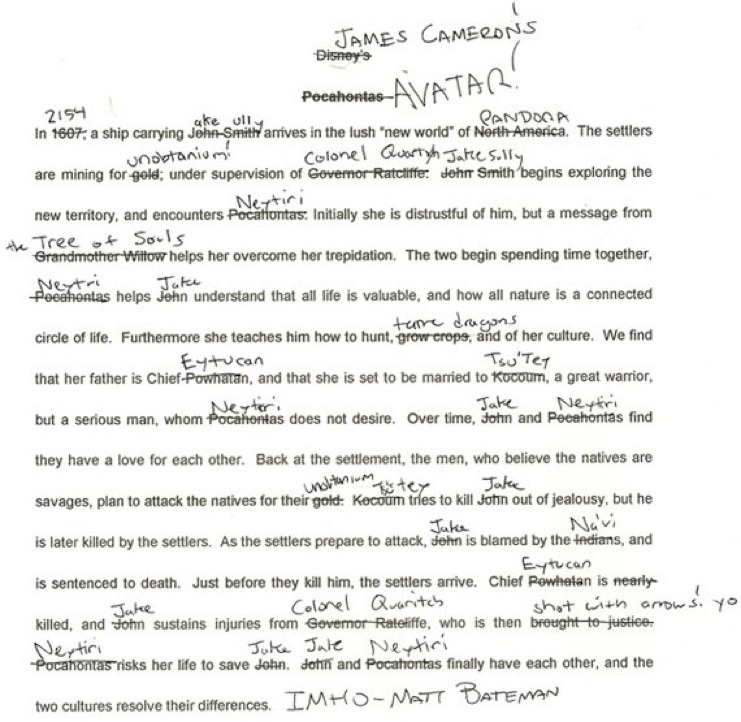
2. I went on and on (and on) about the recycling programs set up for the 3d glasses used when watching movies like Avatar, and didn't even think to comment on the message of the film. Which is that, um... trees are good. Or something.
I will try to keep this spoiler-free, as there doubtlessly people among my several-hundred-million-strong readership who have yet to see Avatar. (I mean, just look at that followers list, it's pretty out of control.) But then again, who hasn't seen Avatar yet?
Alas, that is not the point, I will keep this spoiler free on principal, as people who spoil movies sit comfortably between Pol Pot and Idi Amin on the list of detriments to the human race.
So the basic plot of Avatar is this: it's FernGully, except in space and with blue-cat/lizard people.
A more in depth analysis is this though:
About 150 years in the future, a human mining corporation has set up a colony on a recently discovered moon called Pandora, where they are attempting to mine (I shit you not) unobtainium. Despite being the most idiotically named mineral ever, unobtainium is apparently quite valuable, so this mining corporation is willing to do anything to get there hands on it, including wiping out Pandora's indigenous population of Native American stereotypes. The Pandoran natives, called the Na'vi, are the blue, half-cat, half lizard (all sexy) people that I referred to earlier. They have a communal bond with the flora and fauna of Pandora, believing in the existence of a mystical spirit running through all of creation.
So a quick recap: Evil mining corporation vs. Nature-loving Na'vi.
You can guess where it goes from there.
The theme of the destruction of nature at the hands of mankind runs deep throughout the film. It really is, despite what the clumsy romance may lead you to believe, the crux of the narrative. It is a story about the clash of two completely different worlds, and the harsh consequences that can come to be when those two worlds don't operate in harmony. Like a Prius.
The parallels between the corporation's quest for unobtainium (I swear to god I thought it was a joke too) and our own quest for oil are clearly drawn. The manner in which we have ravaged the earth's environment to make way for everything from oil fields to livestock grounds is directly alluded to with the corporation's propensity for bulldozing Pandoran forest.
And by bulldozing, I mean blowing up.
Because in the future they don't have time for bulldozers.
And while the message of the film is an important one, it is one that we have heard so many times before.
Again, this is an valuable moral that writer/director James Cameron is trying to get across, and clearly, a lot of people are being exposed to it, so it's redundancy should not be judged too harshly. What should be judged harshly is the ham-handed way in which it is delivered. (I'm looking at you, dialogue and plot contrivances!) But that is neither here nor there.
I appreciate that such a widely viewed entertainment phenomenon is actually packing a good message. You don't see that very often, if at all. So bravo, Avatar's marketing team! You did a good job exposing this movie to the world. It's an amazing film, with a great story about the dangers of destroying environment, so if you haven't seen it, go do so. Lord knows it needs all the money it can get at the box office.
FAIR WARNING ALERT: This post is largely about the state of popular music, specifically what your grandmother might refer to as, "that rap music," or something much more racially insensitive, depending on you grandmother's worldview. Needless to say of any blog post about said topic, the following contains a ridiculous amount of links to videos with some morally questionable lyrics and A LOT of swearing.
If you are easily offended by such things, are in the vicinity of anyone who is (like your racist grandma), or are currently at any place that is not your own home, I highly recommend postponing any link-clicking that the following musings may inspire until a time at which the offense will be negligible. Thank you. You may now proceed to my rant.
I just got back from dropping off some movies at Blockbuster, which is exactly 14 blocks from my house . But that's not important, just a little frame of reference. In that time, I was able to hear two songs on the radio. (94.9 Jams of course! ...or is it Jamz?) I didn't know who either of the artists were, but I would describe one song as a Lady Gaga-esque pseudo house/pop infusion dance number, and the other as what I lovingly refer to as Shit-Rap.
Let me start with the Shit-Rap. Again, no idea who the particular rapper was, but he made Gucci Mane sound like fucking Hemingway. The hook consisted of little more than a list of women's names (there may have been a guttural grunt or two thrown in for good measure - my memory is hazy). It was all delivered in a gravelly, monotone voice (think Lil' Jon after puberty), and of course, the beat sucked. I mean it is on the radio after all.
Turns out this song is the 2004 classic "Freek-a-Leek" by Petey Pablo, which is Spanish for Petey Paul. And it was, in fact, produced by none other than Lil' Jon himself.
Don't get me wrong, Lil' Weezy makes interesting, infrequently great, music, and occasionally stumbles upon a good pun; but when you're putting out thousands (literally) of songs each year, and you get a few good verses in, that does not make you a good rapper. At all. Not even close.
Damn. I went off on a tangent while going off on a tangent.
Getting back on track. So this mystery rapper, whoever he may be, is clearly just some shill, a point emphasized when he stops "rapping" to talk over the track. Verbatim: "I gotta give a shout out to Seagram's Gin, because I drink it. And they paid me." YES. YES. YES. YES. YES. But that's a completely different rant.
Let that bubble in the boiling pot while I move on to the next song.
The Lady Gaga-esque dance number, which I am about 96% sure was in fact Lady Gaga, actually attempted a narrative arc! Horray! +1 for pop music right? Wrong. The story consisted of a girl at a club (shocker!) who was getting "blown up" by some skeezy dude who she wasn't feeling. Na I saying? I mean, we've all been there, right?
Good lord though. This song has to be a joke. A parody of Sambergian proportions. If that is the case, my waning faith in humanity will be temporarily restored. But I don't think it is, not with lyrics to the effect of, "I get no reception in this club" and a guest rap verse featuring a ditty like, "blowing me up more won't get me out of the club faster." We're in Lonely Island territory now.
In the case of both songs, the blunt anti-lyricism is pushing banality to the extreme, and is doubtlessly a contributing factor to the dystopia that Mike Judge predicted.
Damn, that last sentence sounds like something out of a Pitchfork review.
The point is, shit like this is dumbing people down. Quality, message-driven music being completely ignored by pop culture is nothing new. People don't want to be intellectually stimulated by a club track, and I understand that (the club is for other kinds of stimulationHEYO!).
The problem is, people will listen to this ALL THE TIME. The number one song on iTunes right now is called Blah Blah Blah for godsakes. (I'm amazed they couldn't work a hip misspelling in there somewhere. Oh wait. There it is. The artist's name is Ke$ha. Of course. U! S! A!)
Pop music has gone beyond simply recycling archetypes and ripping off the last hit. Innovation now stands somewhere in between basing songs around a function of technology and MAKING SHIT UP. Buddha help the people that have to grown up with this stuff ingrained in their psyche.
Geez that was a long rant. And to what end? Well. Here we go.
Those people that have to grow up being inculcated by this music? Those are the people we are expecting to save the world. We've gotten to a point with the environment where nothing but radical action is going to be able to do anything. And who do we have to call saviors? A generation of people made so lazy by the wonders of technology, and so thoroughly dumbed-down by pop culture's hysterical decline into self-parody that they won't have the drive, much less the means to do anything to help us.
What I'm saying is that we won't be able to do what every generation before ours has done; we won't be able to put off the problem until future generations can fix it. Because future generations are going to be a scary ones. (Wall-E spoilers)
My drive back from Blockbuster was brought to a poignant end when an empty Doritos bag floated across the street, adrift in a gust of wind. "If only that was a Sun Chips bag..." I lamented to myself.
Epilogue:
My paranoia may lead you to believe that I am off that chronic. I am not.
My anger may lead you to believe that I am off that drank. I am not.
If only I could blame it on the al... you know where this is going:
So I'm coming to realize that I have quite the cynical view of... well, everything. And that has certainly shined through in these first few posts. But you have to understand, anything that is not Arvydas Sabonis is met with immense skepticism and bitterness on my part.
But I'm going to attempt to be a little more positive in this post.
I'm not very good at this positivity business. I think I'll go watch Rush Hour. Hopefully that will put me in a better mood, and make this a little easier.
Ah. That's a good movie. Always a treat.
Anyway, back to my original point. SO. These guys. Ted Nordhaus and Michael Shellenberger. They wrote this essay, a couple years back. Called it, (PDF WARNING!) The Death of Environmentalism. Pissed a lot of people off. Why? Because environmentalists love environmentalism. And These guys were saying it was dead. That's like... that's like a veterenarian writing a book called The Death of Puppies. That'll make people cry. Everybody loves puppies.
Nordhaus and Shellenberger argue that environmentalists have actually set their own movement back by doing something that is, like sex and violence, quite popular among members of the human race: short-term thinking.
They don't question environmentalist's resolve or motives; they're not accusing environmentalists of greenwashing; they're simply saying that the steps environmentalists have been recommending for decades aren't going to solve the problems that face the planet these days. Basically, they say environmentalists are thinking too small.
Sure, buying a hybrid or coating your house with solar panels is good, (or at least better than driving a dumptruck around or heating your house with whale blubber) but Nordhaus and Shellenberger would argue that it is not enough. Even if everyone in the country did that, it wouldn't offset the harm we are still doing to the environment. Their basic argument is that the only way to prevent deterioration of human habitat is to DRASTICALLY reinvent how our industry functions.
Not just churning out recyleable whatnots and hybrid hootenannies, but completely changing the means of production within industry so as to make ours a truly viable, sustainable way of life. Of course, their plan would involve such a radical overhaul of how we do things that it would cost millions of jobs and billions of dollars.
Nordhaus and Shellenberger openly admit this, and counter with the notion that to save the earth in the long run, sacrifices need to be made in the short run. If the entire workforce of the United States could be trained to operate within their proposed sustainable industry, their plan would generate even more jobs than it initially lost.
Here is an article from Wired about the two, in which a much smarter person than myself talks much more intelligently about the subject than I possibly could, while also providing a great outline of Nordhaus and Shellenberger's proposal.
And yes, I realize the fitting nature of me lifting my veil of cynicism and making my first positive post about a pair of cynics. Go me.
Anyway, it's another acronym organization's "Green Week." This time, it's not the National Basketball Association, it's the National Broadcasting Company. The premise of NBC's Green Week is simple; for a certain week every year, all of NBC's programs have a "Green" theme, be it a storyline in a sitcom, or special green activists as guests on a talk show. Or both, like on 30 Rock:
It's funny because he recycled a joke from his previous Green Week appearance! AHAHAHAHA! (Seriously though, 30 Rock has sucked this season.)
While this is a great idea, and it worked out decently in a few shows, overall I can't say it's been a success. It usually just comes down to a recurring joke about the Green Movement throughout an episode, or a quick bit, punctuated by marginally useful facts about "conservation."
Like this one, from The Office:
AHAHAHAHAHAHA! (The Office has been pretty hit or miss this season. But I guess that's better than the abject failure of every season since season 2)
The problem with most of NBC's Green Week programs is that there is just a mandate handed down to the writers, forcing them to put "Green Themes" in episodes. This ends up getting in the way of both storytelling and the message of sustainability, leaving viewers with a week of bad, uninformative (unless you didn't know recycling was a good idea) television.
Maybe giving the writers a little more of a heads up about when Green Week is coming could help them work outside themes into ongoing storylines with a little more grace. As it is now, it's generally considered contrived to have characters yelling out a line like, "That's aerosol spray! It's terrible for the environment!"
Here's a clip from NBC's rookie sensation, Community:
(Give it up for Community for being surprisingly watchable. Who would've thought that ol' Chevy Chase still had anything left in the tank?)
It also boasts the best outcome of Green Week, because it provides some mildly scathing commentary on the hypocrisy of Greenwashers. By actually pointing out a problem with the Green Movement, Community introduced some (sort of) discussable material which contrasted nicely with the pandering, forced themes in other shows.
The fact that the best thing to come out of Green Week was practically mocking the Green Movement? Let's call it equal parts critique and omen.
A rather incredible "phenomenon" (if you're feeling dramatic) occured in the first days of the new year. Director James Cameron's remake of Pocahontas (which he calls Avatar)made a LOT of money. Since it's release on December 18th, 2009, Avatar went on to gross over 1 BILLION dollars in just 17 days. (DAAAAAAAYUM.) That feat set it up as the forth highest grossing movie of all time, and solidified James Cameron as the only director to have two films make over a billion dollars.
And all of that despite being a big budget remake of Pocahontas! (WARNING: Mad spoilers abound - don't click if you haven't seen Avatar/Pocahontas. Or FernGully: The Last Rainforest, they're all basically the same movie.)
Of course, it's a lot easier to make money at the box office when your film is released in 3d, and a neato pair of sunglasses has to be packaged with every ticket and you get to charge twice as much as regular tickets.
WHEW! That finally brings me to my point.
"SO! Film industry! You've just stumbled upon a new way to display movies that makes you twice as much money, what are you going to do!?!?!?"
"We're going GREEN!"
Of course you are.
Naturally, cinemas across the country want to appear to be environmentally friendly, so what do they do? Why, put out handy little boxes to recycle your 3d glasses at the exits to the theater, duh.
Instead of encouraging movie goers to hang on to their glasses and use them for future 3d movie going experiences, they ask that you give them back the glasses you just paid for so they can dip them in some anti-bacterial juju, then repackage them in little plastic bags (which are of course thrown away as soon as one takes the glasses out), and resell them with next week's showings of Avatar.
Long rant short: This is exactly the kind of half assed "Green Branding" that is setting the concept back. It's a rather obvious ploy by the powersthatbe to vastly increase profits and appear to be environmentally conscious without really doing anything eco-friendly. I mean, yes, it is better than just throwing the glasses away, but the fact that the decision is based on profit, not true environmentalism, is bothersome.
Luckily for hipsters, wearing RealD glasses outside of a theater in place of regular glasses is SUPER ironic, so that's a cool way to recycle them.
Sorry. That slipped out.
But if, by chance, you didn't click on the Avatar is the same movie as Pocahontas link, you totally should. It is absolutely uncanny. Hell, here's another shot at it: BOOM. (Again, mad spoilers)
Alright, so this time I'm going to start out with a commercial. It's one of Toyota's many ads for the Prius.
Aside from being bizarre and fascinating, the ad's visuals relate back to the theme of the commercial about harmony between humans, nature and, well, Priuses. (What is the plural of Prius? Prii?)
Above all though, they kind of distract from the message of the ad. I actually thought it was a commercial for a Civic Hybrid and wasted about ten minutes scouring youtube for "that Civic commercial where the grass and stuff is people." I felt quite the fool. Twas lovely.
But yeah, I'm going to say that renders the ad rather ineffective, but I suppose one could make the same argument about my sensoryorgans.
But that is just my rant about the ad's visuals. What I want to get at is the inherent problem that the ad represents about Green Brand Strategies. Now, I understand that the Prius is, like, the Citizen Kane of green brands, and that it has become a rallying cry for wannabe-environmentalists and fuel conservationists alike. In that sense, it represents the best possible endgame for green brands; benefit for both the consumer and the earth.
The problem (beside the idea that Hybrid Cars are a solution to the environment's slow death ) is that few other green brands offer the same dually beneficial aspect that Hybrids offer. Does "environmentally friendly dish soap" work any better than regular dish soap? No. Does it work at all? No. Well, just barely. But regular dish soap is much better at cleaning dishes. A fact I discovered after spending winter break testing out my mom's new dish soap: ECOSUDS! Or something cute like that.
In order for green brands to really take off and be more than a greenwashed fad, they have to benefit the consumer in some way. Don't punish the consumer for trying to "help" the environment, because ultimately, consumers are going to take what benefits them the most, regardless of its effect on the world. Why? Because humans don't give a fuck. Evidence: The State of the Earth. We're roughly 25 minutes into a Roland Emmerich movie here.
So Hybrids are a good step for Green Brands. For actually helping the environment? Not so much.
So... for my first post, I suppose I'll just talk about my personal favorite "Green Campaign." Which is, of course, the National Basketball Association's Green Initiative.
NBA Green consists mainly of team-based programs, like the Toronto Raptors encouraging public transportation by offering 25% discounts on tickets to any fan with a public transit receipt, or the Cleveland Cavaliers switching out all of the plastics in their arena for biodegradable corn plastic. The campaign's focal point is "NBA Green Week" which consists of some teams uncharacteristically sporting green jerseys as well as... um... Green Week T Shirts. And yeah. That's about it.
So if you see the Bulls rocking green jerseys, it's not Bizarro Word, it's just NBA Green Week.
It's a pretty basic green program, with both teams and the league as a whole trying to, above all, increase awareness for the "Green Movement." It's effect is hard to judge, but hey, they're trying, and that's what people like to see.
And you've got to love anything that produces this photo:
That's the photo you want headlining your website.
This just screams, "Hey kids! Did you recently come across a stack of unused newspapers or a (probably full) can of soda? Recycle that shit!" Boom. Message received. God bless the NBA.
Sidebar: Is that the bunny from Donnie Darko helping Elton Brand recycle? What the hell? How did they get that thing in a Sixers jersey? It looks fairly foul-tempered, like it would teach you how to recycle, then promptly reap your soul.
 Grrrrrrrrrrrrrrrrrrr...